


How can CNC turning reduce error accumulation and improve overall accuracy?
Release Time : 2026-01-14
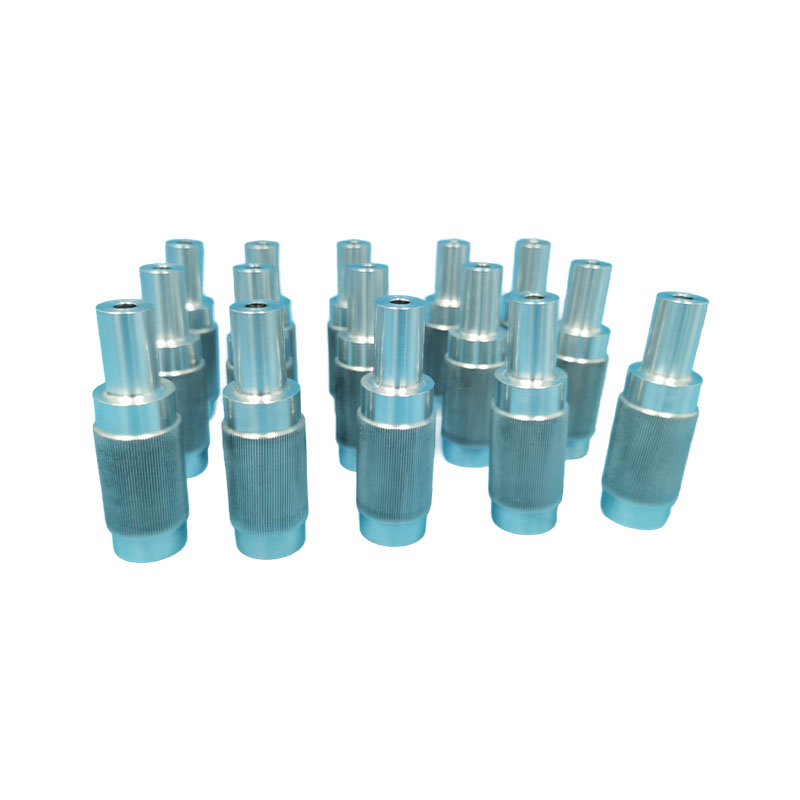
In the world of precision manufacturing, even minute deviations often mean functional failure or even safety hazards. This is especially true when machining aluminum parts for medical devices, optical instruments, or high-end automated equipment, where requirements for dimensional consistency, geometric tolerances, and surface integrity are extremely stringent. One of the core advantages of CNC turning technology, which has become the preferred choice for high-precision aluminum parts manufacturing, is its ability to achieve "one-time clamping, multi-process integration"—completing external turning, internal boring, grooving, chamfering, threading, and even some milling operations in one continuous process without removing the workpiece from the chuck. This seemingly simple process optimization fundamentally breaks the chain of error transmission, building an invisible defense line for overall precision.
In traditional machining, if multiple surfaces or features need to be machined, the workpiece often needs to be disassembled and repositioned multiple times on different machine tools or on the same machine tool. Every clamping operation, no matter how standardized, inevitably introduces new datum offsets—minor looseness of the fixture, differences in the cleanliness of the locating surfaces, and visual errors in human alignment can all cause subtle changes in the workpiece coordinate system. These seemingly insignificant deviations can be significantly amplified after multiple processes, ultimately leading to problems such as out-of-tolerance coaxiality, excessive end face runout, or hole position misalignment. Even more problematic is that these errors are often difficult to trace, requiring repeated trial cuts and measurements for correction, which is both time-consuming and impacts yield.
Modern CNC turning, especially milling and turning centers equipped with powered turrets and C-axis control, has completely changed this situation. After initial clamping, the system uses its rotation center as the sole datum, and all subsequent toolpaths are precisely calculated around this axis. Whether machining external contours or deep hole walls, whether turning end faces or milling lateral keyways, all actions are completed in the same coordinate system. Without secondary positioning, there is no datum transformation; without datum transformation, the cumulative errors caused by it are eliminated. This "unchanging amidst change" processing logic ensures a high degree of consistency in the positional relationships between various features—like drawing continuously on the same sheet of paper with a single pen, the lines are natural, coherent, and without any misalignment.
Furthermore, single-clamping significantly reduces human intervention and handling. The workpiece does not need to move between lathes, milling machines, and grinding machines, avoiding bumps during transportation, micro-deformation caused by changes in environmental temperature and humidity, and uncertainties arising from differences in operator techniques. The entire processing is precisely controlled by the program, with extremely high repeatability, making it particularly suitable for the stringent consistency requirements of mass production.
Furthermore, this integrated processing can optimize surface quality and structural integrity. For example, when machining thin-walled aluminum cylinders, multiple clamping operations can cause elastic deformation with each clamping force, leading to dimensional distortion upon release and rebound. However, a low-stress cutting strategy employed in a single clamping operation, combined with a reasonable toolpath, can maximize the preservation of the workpiece's original state, achieving more accurate geometric precision. Meanwhile, continuous processing avoids the impact of residual aluminum shavings or oxide film formation during process intervals on subsequent surfaces, providing a cleaner and more uniform foundation for post-processing such as anodizing and spraying.
Ultimately, the high precision of CNC turning stems not only from the rigidity of the machine tool itself or the advanced control system, but also from its profound understanding of the essence of the manufacturing process—reducing variables increases certainty; simplifying processes ensures quality. When an aluminum part, from blank to finished product, remains consistently aligned with the same benchmark, every dimension and every contour has a reliable place.
Because in precision manufacturing, true precision is not achieved through later corrections, but rather from its very beginning. The wisdom of a single clamping operation is the key to safeguarding this "never-lost" precision.
In traditional machining, if multiple surfaces or features need to be machined, the workpiece often needs to be disassembled and repositioned multiple times on different machine tools or on the same machine tool. Every clamping operation, no matter how standardized, inevitably introduces new datum offsets—minor looseness of the fixture, differences in the cleanliness of the locating surfaces, and visual errors in human alignment can all cause subtle changes in the workpiece coordinate system. These seemingly insignificant deviations can be significantly amplified after multiple processes, ultimately leading to problems such as out-of-tolerance coaxiality, excessive end face runout, or hole position misalignment. Even more problematic is that these errors are often difficult to trace, requiring repeated trial cuts and measurements for correction, which is both time-consuming and impacts yield.
Modern CNC turning, especially milling and turning centers equipped with powered turrets and C-axis control, has completely changed this situation. After initial clamping, the system uses its rotation center as the sole datum, and all subsequent toolpaths are precisely calculated around this axis. Whether machining external contours or deep hole walls, whether turning end faces or milling lateral keyways, all actions are completed in the same coordinate system. Without secondary positioning, there is no datum transformation; without datum transformation, the cumulative errors caused by it are eliminated. This "unchanging amidst change" processing logic ensures a high degree of consistency in the positional relationships between various features—like drawing continuously on the same sheet of paper with a single pen, the lines are natural, coherent, and without any misalignment.
Furthermore, single-clamping significantly reduces human intervention and handling. The workpiece does not need to move between lathes, milling machines, and grinding machines, avoiding bumps during transportation, micro-deformation caused by changes in environmental temperature and humidity, and uncertainties arising from differences in operator techniques. The entire processing is precisely controlled by the program, with extremely high repeatability, making it particularly suitable for the stringent consistency requirements of mass production.
Furthermore, this integrated processing can optimize surface quality and structural integrity. For example, when machining thin-walled aluminum cylinders, multiple clamping operations can cause elastic deformation with each clamping force, leading to dimensional distortion upon release and rebound. However, a low-stress cutting strategy employed in a single clamping operation, combined with a reasonable toolpath, can maximize the preservation of the workpiece's original state, achieving more accurate geometric precision. Meanwhile, continuous processing avoids the impact of residual aluminum shavings or oxide film formation during process intervals on subsequent surfaces, providing a cleaner and more uniform foundation for post-processing such as anodizing and spraying.
Ultimately, the high precision of CNC turning stems not only from the rigidity of the machine tool itself or the advanced control system, but also from its profound understanding of the essence of the manufacturing process—reducing variables increases certainty; simplifying processes ensures quality. When an aluminum part, from blank to finished product, remains consistently aligned with the same benchmark, every dimension and every contour has a reliable place.
Because in precision manufacturing, true precision is not achieved through later corrections, but rather from its very beginning. The wisdom of a single clamping operation is the key to safeguarding this "never-lost" precision.